
Certificate in Medical Laboratory Technology
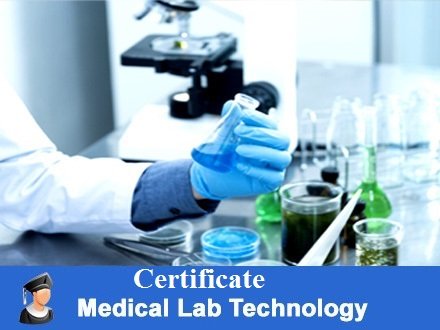
With increasing awareness about healthcare, people have been participating actively when it comes to their health and wellbeing. Owing to this, the demand for well-trained medical lab technicians has increased. As a result, such courses have become more popular.
Medical lab Technicians help diagnose and prevent various diseases such as cancer, AIDS, diabetes, etc. They work under the supervision of Physicians and Medical Technologists and take samples and perform laboratory tests.
ABOUT THE COURSE
Certificate in Medical Laboratory Technology is a short-term specialization course. Certificate Course in Medical Laboratory Technology concerns the prevention, diagnosis and treatment of diseases through the clinical laboratory test.
The course help students to learn how to diagnose, detect, and treat diseases. With this certificate course, students also study the sampling, reporting, testing, and documentation of the clinical tests.
DURATION
1 year
ELIGIBILITY
10th, 12th, or equivalent certification with a minimum of 50% marks from a recognized board.
WHY STUDY CERTIFICATE COURSE IN MEDICAL LABORATORY TECHNOLOGY COURSE?
The main aim to attain a Certificate Course in Medical Laboratory Technology course will depend on the student's interest and goals. Some of the reasons to get into this certificate course are as follows-
- Highly Reputed Profession: Medical certificate course is a highly demandable course one can opt to choose. Students with a graduate degree can find a job immediately. It is one of the oldest and most reputed courses among the students.
- High pay scale: Average medical laboratory technology certificate course packages are higher for private and public organizations. The medical laboratory technology work involves Laboratory Technician, Technology Manager, Laboratory Manager, Medical Officer, Research Associate, Lab Assistant and many more.
COURSE ADVANTAGES
- Certificate Course in Medical Laboratory Technology concerns the treatment diagnosis. It helps prevent diseases with the help of clinical laboratory tests.
- This course will teach students all the skills required to handle advanced equipment to perform precise laboratory tests.
- This medical laboratory course guides instructions about automated, semi-conducted, and blood count cells.
- In this course, students study essential topics, including basic immunology, metabolism and genetics, cultural characteristics, microbial morphology, and theory of disease process.
- Students learn how to perform the tests that help diagnose and treat diseases. They also get to learn the formation of various hematologic disorders like anaemia.
DIFFERENCE BETWEEN LAB TECHNICIANS AND LAB TECHNOLOGISTS
There are two types of medical laboratory workers - Technicians and Technologists.
Technicians work under the supervision of a technologist who has more education and training than a technician.
Medical Technologists
· Perform complex tests such as microscopic examinations of tissues, blood and other body fluids to detect evidence of disease
and detect the presence of bacteria, fungi, parasites etc. and chemical tests to determine blood cholesterol levels.
· Technologists microscopically examine blood and other body fluids.
· Make cultures of body fluid and tissue samples to determine the presence of bacteria, fungi, parasites, or other microorganisms.
· Analyze samples for chemical content or a chemical reaction and determine compounds such as blood glucose and cholesterol levels.
· Match blood samples for transfusions and test drug levels in the blood to determine how patients are responding to medications.
· Are responsible for making sure that testing is done accurately.
· In some labs, technologists conduct research under the supervision of medical researchers.
Medical Technicians
· Work under Technologists or supervisors.
· Carry out routine laboratory testing manually according to instructions.
· May prepare specimens and operate machines that automatically analyze samples.
· Set up, clean, and maintain laboratory equipment, such as centrifuges, microscopes etc.
· Prepare standard solutions for use in the lab. This involves measuring and mixing the correct amount of various chemicals.
SCOPE/ AREA OF WORK
Medical technologists are an integral part of the medical profession. These professionals get involved in practical and technical work to aid the correct diagnosis and effective functioning of Biochemical Laboratories.
The career prospects in this field depend on the academic and technical skills of the technologist/technician. Initially, he/she joins any laboratory as a certified medical laboratory technician. However, these days with the growth in the private sector, there are so many private hospitals, nursing homes, blood banks, pathology laboratories etc. the demand for laboratory technicians is on the upswing.
With adequate knowledge and experience, Medical Laboratory Technologists can advance to supervisory or management positions in laboratories and hospitals. They can also work as a Laboratory manager/Consultant/supervisor, health care Administrator, Hospital Outreach coordination, laboratory information system Analyst/Consultant, educational consultant/coordinator etc. Additional opportunities are available in molecular diagnostics, molecular biotechnology companies and in vitro fertilization laboratories, and research labs.
Medical Laboratory technologists examine and analyze the body's different fluids, tissues, blood typing, microorganisms, chemical analyses, cell counts, etc. They play an essential role in collecting the information needed for treating most pathology cases by sampling, testing, analyzing and reporting such investigations.
- Decisions concerning sample collection and handling
- Daily instrument maintenance and quality control
- Sample testing
- Collection and interpretation of data
- Maintenance of accurate records and reporting of data
- Knowledge about critical values
SPECIALIZATIONS
Some of the areas in which medical lab technicians may specialize in:
- Microbiology
- Haematology
- Blood banking
- Immunology
- Clinical Biochemistry
- Molecular biology
- Histopathology
QUALITIES OF GOOD MEDICAL LAB TECHNICIAN
- Multitasking skills
- Analytical skills
- Problem-solving skills
- Desire to accept the change and challenges
- Ability to work under pressure
NATURE OF WORK
Clinical laboratory personnel
- Determine the presence, extent or absence of disease and provide data needed to evaluate the effectiveness of treatment.
- Play an essential role in collecting the information needed, sampling, testing, reporting and documentation of these investigations.
- Examine and analyze body fluids and cells.
- Look for bacteria, parasites, and other microorganisms; analyze the chemical content of fluids; match blood for transfusions; and test for drug levels in the blood that show how a patient responds to treatment.
- Technologists also prepare specimens for examination, count cells, and look for abnormal blood and body fluids cells.
- Use microscopes, cell counters, and other sophisticated laboratory equipment. They also use automated equipment and computerized instruments to perform several tests simultaneously. After testing and examining a specimen, they analyze the results and relay them to physicians.
JOB OPPORTUNITIES
- Laboratory technician
- Technology manager
- Laboratory Manager
- Medical officer
- Research associate
- Lab Assistant
- Medical Record Technician
- Resident Medical Officer
- Laboratory Testing Manager